
Excellent Reviews on Trustpilot
Verified vending operators sharing real-world results.
-
Mini TCG – Compact Trading Card Vending Machine | VapeTM
Regular price From $2,850.00Regular priceUnit price per -
Slim Wall TCG: Trading Card Vending Machine | VapeTM
Regular price From $3,450.00Regular priceUnit price per -
Mega Wall 2.0 TCG – Trading Card Vending Machine | VapeTM
Regular price From $4,150.00Regular priceUnit price per -
Slim Tower 2.0 TCG: Trading Card Vending Machine | VapeTM
Regular price From $5,000.00Regular priceUnit price per -
Universal VTM Wall Mount Pedestal Stand
Regular price $450.00Regular priceUnit price per -
Top-Loader Vending Cases, 30 Pack | Fits Pokémon Booster Packs
Regular price $30.00Regular priceUnit price per

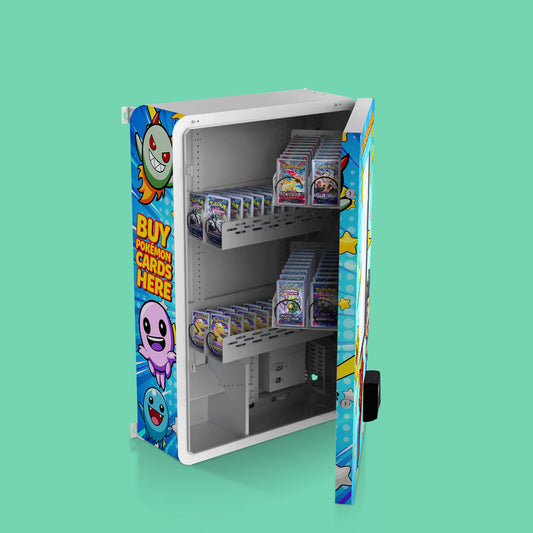

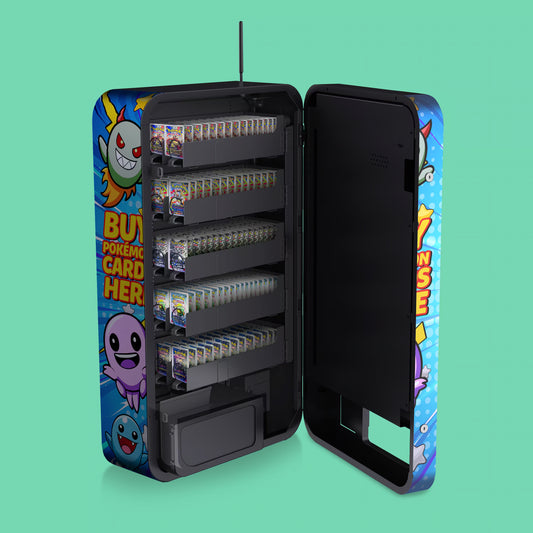

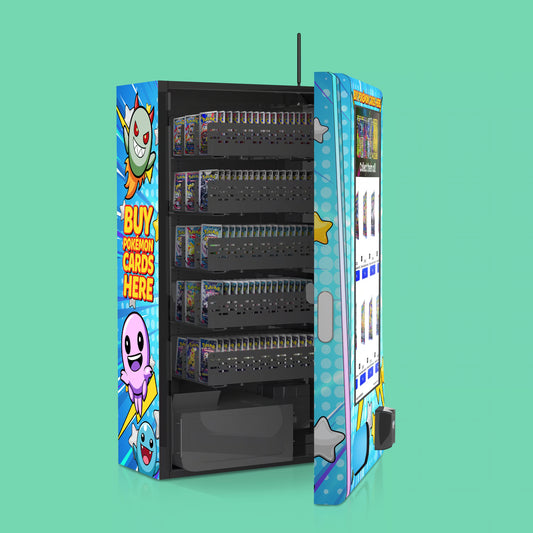

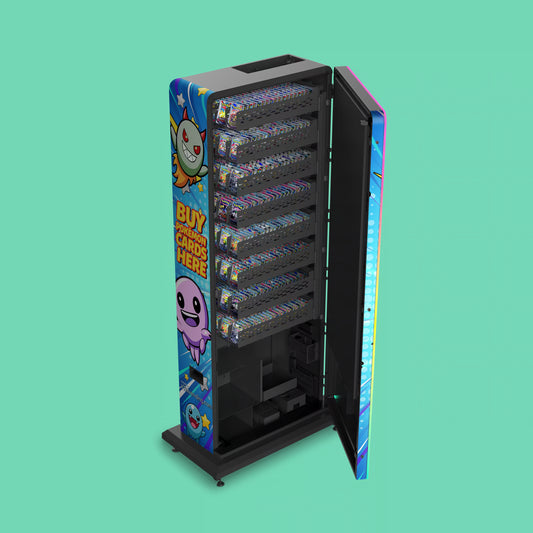

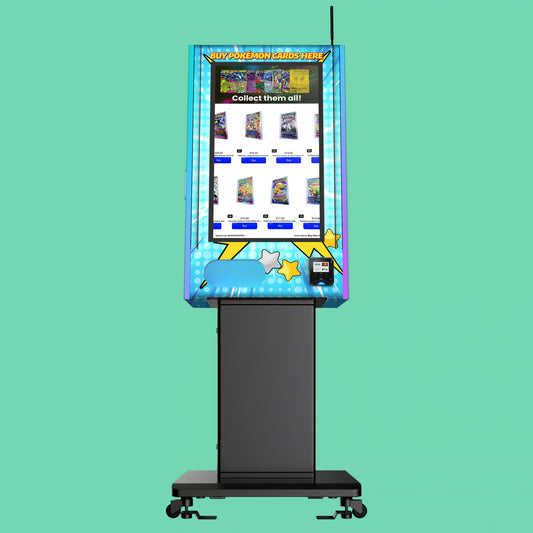

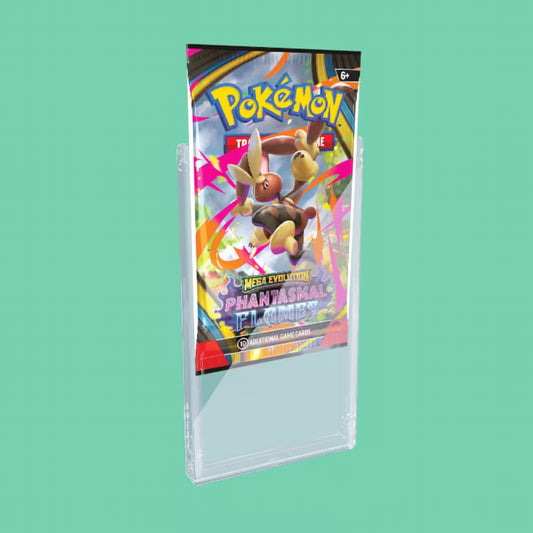
Half the price of $10K Pokemon kiosks. Same Gem Mint delivery.
Pokemon vending machines from other manufacturers cost $10,000 to $15,000 or more. The Elaut Cardset Kiosk lists at $11,675. VMFS USA sits in the same tier. Bigger, heavier, more complex, saddled with expensive robotic elevator arms that "catch" each pack as it falls.
VTM engineered the elevator out. A custom 22mm precision coil sized to the exact width of a Pokemon booster pack, paired with a clear acrylic top-loader case that absorbs the drop. No elevator arm. No $5K mechanical workaround. No service downtime.
Same Gem Mint pack delivery. 21.5", 32", or 43" digital touchscreens depending on the model. Wall-mounted (pedestal-convertible) or free-standing form factors. $2,850 to $5,000. Approximately 3 to 5 month payback at $33 a day average, the per-machine profit a Cleveland Shell location actually printed in 28 days of field data.
Why Operators Are Switching to Pokemon Vending
Beyond the engineering, Pokemon vending unlocks something traditional vending categories can't: unrestricted placement. Pokemon vending isn't age-gated, licensed, or zone-restricted. It's kid-friendly, has good optics for the host location, and is easy to place.
"Locations chase operators, not the other way around."
VTM Stocks the Pokémon Inventory That Goes In the Machine
Most operators chase wholesale Pokémon supply across distributors, eBay breaks, and broken-up retail allocations. We've consolidated it. VTM keeps live Pokémon booster pack inventory across the strongest-selling sets: Mega Evolution, Surging Sparks, Destined Rivals, Obsidian Flames, Stellar Crown, Paradox Rift, Journey Together, Twilight Masquerade, Prismatic Evolutions, and more. Reserved-priority for VTM machine buyers.
Wholesale pricing $7.50 to $17.50 per pack across 18 active SKUs. Packed in top-loader cases, ready to load, in stock now.
What's Included With Every VTM Pokemon Vending Machine
- 22mm Pokemon-pack precision coils: engineered to the exact width of a sealed booster pack
- Nayax VPOS Touch cashless card reader: Apple Pay, Google Pay, EMV chip, NFC tap-to-pay
- Built-in Wi-Fi and high-gain card-reader antennas: no separate router required
- VTM Vending Management System: free Year 1. Real-time inventory, remote pricing, and sales reporting from any iOS or Android device
- 1-Year Comprehensive Warranty: parts, electronics, and full machine replacement if needed
- 30-Day Return Policy: return within 30 days if it's not the right fit
Operator Resources
Pokémon Booster Pack Inventory →
18 live SKUs at wholesale pricing from $7.50 to $17.50. Reserved-priority for VTM machine buyers. Mega Evolution, Surging Sparks, Obsidian Flames, Prismatic Evolutions, and more.
Top-Loader Cases →
$4 per 10-pack. 40¢ per case. Restock supply for the moat.
Profit Calculator →
Run your numbers before you buy. By venue, pack mix, and traffic.
Pokemon Vending Machine FAQ
How much does a Pokemon vending machine cost?
VTM Pokemon vending machines start at $2,850 for the Mini TCG (compact wall-mounted, 21.5" touchscreen), $3,450 for the Slim Wall TCG (32" touchscreen), $4,150 for the Mega Wall 2.0 TCG (high-capacity wall, 32" touchscreen), and $5,000 for the Slim Pack Tower 2.0 (highest-capacity free-standing, 43" touchscreen). Every machine includes 22mm precision coils, Nayax VPOS Touch cashless payment, built-in Wi-Fi, VTM Vending Management Software (free Year 1), a 1-year comprehensive warranty, and a 30-day return policy. Competing elevator-arm kiosks like the Elaut Cardset Kiosk ($11,675) and VMFS USA run $10,000 to $15,000 or more for comparable functionality.
Why are VTM Pokemon vending machines cheaper than Elaut and VMFS kiosks?
VTM engineered out the most expensive component of traditional card vending machines: the robotic elevator arm. Competing kiosks use a complex motorized lift to "catch" each booster pack as it falls. That's a $5,000 mechanical workaround for an under-engineered coil. VTM uses a custom 22mm precision coil sized to the exact width of a Pokemon pack, paired with a clear acrylic top-loader case. Same Gem Mint pack delivery, fraction of the cost.
What Pokemon sets and product sizes fit a VTM TCG vending machine?
VTM's standard 22mm precision coils dispense any sealed standard Pokemon booster pack, including Mega Evolution, Destined Rivals, Surging Sparks, Stellar Crown, Journey Together, Obsidian Flames, Paradox Rift, Twilight Masquerade, Prismatic Evolutions, and the Scarlet & Violet base set. 35mm coils are available for sleeved booster packs. 50mm or 55mm coils accommodate Pokemon mini-tins, Elite Trainer Boxes (ETBs), and oversized special editions. All non-standard coil sizes are sold separately.
How profitable is a Pokemon vending machine?
VTM Vending sells wholesale Pokémon booster packs to machine buyers at $7.50 to $17.50 per pack. Suggested vend price uses the formula (cost x 1.20) + $8.00, rounded up to the nearest $0.50, which produces $9.50 to $11.50 profit per pack across the 17-set lineup. Real field data from a single VTM TCG machine deployed at a Cleveland, Ohio Shell station over 28 days: $2,057 gross revenue, $922 gross profit, 44.8% blended margin, or about $33 a day. That puts payback against machine price at approximately 2.9 months for the Mini TCG ($2,850), 3.5 months for the Slim Wall ($3,450), 4.2 months for the Mega Wall 2.0 ($4,150), and 5.1 months for the Slim Pack Tower 2.0 ($5,000). Real numbers vary by venue traffic, pack mix, and operator pricing. Run your own scenario in the Profit Calculator or read the full Cleveland case study.
Where should I place a Pokemon vending machine?
The highest-performing placement venues are family entertainment centers, bowling alleys, gas stations, c-stores, malls, and other high-traffic locations. Pokemon vending isn't age-gated, so location owners welcome these machines as a positive amenity. Machines should be visible from main walking paths and require only a standard 110V outlet. Built-in Wi-Fi with a high-gain antenna handles the rest.
Do I need anything besides the machine?
Three things: (1) a 10-pack of top-loader vending cases ($4, restock supply), (2) Pokemon booster pack inventory sourced through VTM (reserved-priority for our machine buyers), and (3) a placement location. The machine arrives fully assembled. Plug into a standard 110V outlet and you're vending. The pedestal stand is optional for converting Mini, Slim Wall, or Mega Wall 2.0 models from wall-mount to free-standing.
Does VTM ship Pokemon vending machines nationwide?
Yes. VTM ships fully assembled Pokemon vending machines to all 50 U.S. states. Specific shipping timelines vary by model and are listed on each individual product page. All machines include a 1-year comprehensive warranty (parts, electronics, full machine replacement if needed) and a 30-day return policy.
Does VTM stock Pokémon booster pack inventory for vending machine customers?
Yes. VTM keeps live Pokémon booster pack inventory across the strongest-selling sets: Mega Evolution, Surging Sparks, Destined Rivals, Obsidian Flames, Stellar Crown, Paradox Rift, Journey Together, Twilight Masquerade, Prismatic Evolutions, and more. Reserved-priority for VTM machine buyers. Wholesale pricing ranges from $7.50 to $17.50 per pack across 18 active SKUs. Browse current inventory at /collections/pokemon-booster-packs.
Can the same machine vend other items besides Pokémon packs?
Yes. A coil change converts a VTM TCG vending machine to vend other product categories, including other trading cards, candy, snacks, and electronics. Larger coils (35mm, 45mm, 50mm, 55mm) are sold separately and are matched to the dimensions of the product being vended. Operators frequently run mixed-category machines (such as Pokémon packs plus snacks) by configuring different coil sizes across the shelves.
What's the difference between the 4 VTM TCG vending machine models?
Mini TCG ($2,850) is the compact wall-mounted kiosk with a 21.5" touchscreen. Smallest footprint, lowest price, ideal for tight placements. Slim Wall TCG ($3,450) upgrades to a 32" touchscreen with more capacity. Mega Wall 2.0 TCG ($4,150) keeps the 32" touchscreen and adds significantly more pack capacity for high-traffic venues. Slim Pack Tower 2.0 ($5,000) is the only model that ships free-standing by design, with a 43" touchscreen and the highest capacity. Mini, Slim Wall, and Mega Wall 2.0 all mount on a wall or convert to free-standing with the optional pedestal stand. Capacity figures are listed on each individual product page below.
Questions or want financing options?
Call (888) 373-8158 to walk through model options and financing.
Call (888) 373-8158Trademark notice. Pokémon and all related names, characters, logos, and trademarks are property of Nintendo, Game Freak, Creatures Inc., and The Pokémon Company International. VTM Vending (operating as VTM Vending) is not affiliated with, sponsored by, authorized by, or endorsed by any of these entities. Magic: The Gathering, Yu-Gi-Oh!, One Piece TCG, and Lorcana are trademarks of their respective owners. VTM Vending manufactures and sells vending hardware and accessories only. We do not distribute, license, or resell trading cards. Operators are solely responsible for sourcing authentic, properly licensed inventory and complying with all applicable trademark and resale laws.